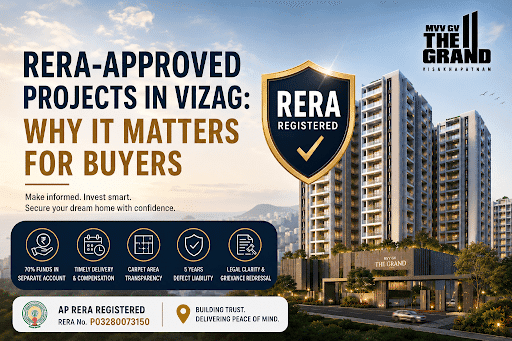
RERA-Approved Projects in Vizag: Why It Matters for Buyers
Buying a home is one of the biggest financial decisions most people make. In a growing city like Visakhapatnam, buyers have plenty of choices across established neighbourhoods and emerging corridors. But before comparing amenities, floor plans, views, or prices, there is one question every buyer should ask:
Is the project registered under RERA?
For anyone searching for RERA-Approved Projects in Vizag, understanding the difference between a RERA-registered project and a project that is simply advertised as “approved” can make a significant difference.
The Real Estate (Regulation and Development) Act, 2016 was introduced to improve transparency, accountability and protection for real-estate buyers. In Andhra Pradesh, projects covered by the legislation are registered with the Andhra Pradesh Real Estate Regulatory Authority (AP RERA). The Ministry of Housing and Urban Affairs identifies AP RERA as the regulatory authority for Andhra Pradesh.
For homebuyers in Vizag, RERA is not merely another certificate to look for in a brochure. It gives buyers access to important project information, financial safeguards, timelines and regulatory mechanisms that can help them make a more informed decision.
What Does “RERA-Approved Project” Actually Mean?
There is an important terminology point that buyers should understand.
“RERA-approved” is commonly used in real-estate marketing, but “RERA-registered project” is the more precise legal term.
A project that falls within the scope of RERA must generally be registered with the applicable state RERA before it can be advertised, marketed or sold, subject to the exemptions provided under the law.
Registration requires promoters to provide project-related information and documents. AP RERA project records can include details such as approvals, project plans, financial information, agreements, title documents and other disclosures.
So, when comparing RERA registered projects in Visakhapatnam, don’t simply ask a salesperson:
“Is this RERA approved?”
Instead, ask:
“What is the AP RERA registration number, and can I verify it on the official AP RERA portal?”
That simple step can help you distinguish between a genuine registration and a vague marketing claim.
Why RERA Matters When Buying a Home in Vizag
Visakhapatnam’s real-estate market includes established residential neighbourhoods as well as rapidly developing areas such as Madhurawada, Pothinamallayya Palem, Anandapuram, Tagarapuvalasa and other growth corridors.
As a buyer, you may encounter projects with different combinations of planning approvals, permissions, registrations and developer claims.
This is where understanding RERA vs VMRDA becomes important.
A planning or layout approval and RERA registration serve different purposes. A project can require local planning permissions while also being subject to RERA requirements. One should not automatically be treated as a substitute for the other.
VMRDA approval does not mean that a project is automatically RERA-registered.
Likewise, seeing a RERA registration number does not mean you should stop checking title documents, sanctioned plans, construction quality, financial terms or other approvals.
RERA should be viewed as an important layer of buyer protection—not a replacement for due diligence.
8 Major Benefits of RERA Projects in Vizag
1. Greater Transparency Before You Buy
One of the biggest advantages of RERA is access to project information.
AP RERA requires promoters to disclose relevant project information for public viewing. AP RERA materials specifically identify disclosures relating to apartment numbers, types, carpet area, completion timelines, approvals and land documents.
This matters because buyers should not have to rely entirely on:
- Sales brochures
- WhatsApp messages
- Verbal promises
- Sample-flat presentations
- Promotional advertisements
Instead, you can cross-check important information against the project’s regulatory disclosures.
What should you compare?
Before booking, compare the information in the sales material with the information available through AP RERA, including:
- Project name
- Promoter name
- RERA registration number
- Number of units
- Project status
- Proposed completion date
- Approved plans
- Carpet area
- Available project documents
- Construction updates
- Financial disclosures where applicable
2. Protection of Project Funds
Financial discipline is one of the most important reasons buyers look for RERA registration.
Under RERA, 70% of amounts realised from allottees are required to be deposited in a separate account for the project, with withdrawals linked to the project’s percentage of completion and supported by certification requirements. AP RERA’s handbook explains this mechanism, while AP RERA’s 2025 directions further address the operation of designated project bank accounts.
The purpose is straightforward:
Money collected for one project should be subject to controls designed to ensure that it is used for that project’s land and construction costs.
This is particularly relevant for buyers who are committing a substantial portion of their savings or taking a long-term home loan.
It does not mean that RERA eliminates every financial risk associated with property purchases. However, the regulatory framework creates greater financial accountability than a buyer would have when dealing with an unregulated transaction.
3. Better Visibility Into Project Progress
Buying an under-construction apartment involves a degree of uncertainty.
You are paying today for a home that may be delivered months or years later.
RERA helps reduce information gaps by requiring project-related updates and disclosures. AP RERA records include quarterly update information, and the authority maintains status information for registered projects.
For buyers, this means you can look beyond a developer’s verbal assurance and examine the project’s regulatory information.
A useful habit is to compare:
Promised progress → Actual site progress → AP RERA updates
For example, if a project is marketed as approaching a particular construction milestone, buyers can review available regulatory information and site progress before making additional payment decisions.
4. Greater Clarity About Carpet Area
Another major RERA benefit is greater clarity around the area of the apartment being sold.
RERA focuses on carpet area, helping buyers compare homes using a more meaningful measure of usable internal space rather than relying only on super built-up or saleable area.
AP RERA project records can display carpet-area information for individual units.
Why does this matter?
Imagine two apartments advertised as having similar “saleable areas.”
One may provide substantially different usable internal space.
Instead of comparing only:
“How many square feet is the apartment?”
ask:
“What is the RERA-declared carpet area?”
Then compare the price on a like-for-like basis.
This can make your property comparison much more meaningful.
5. Protection Against Certain Construction Defects
RERA also provides an important post-possession protection.
Under Section 14, the promoter is liable to rectify structural defects and certain other defects in workmanship, quality or provision of services brought to the promoter’s notice within five years from the date of possession, subject to the statutory conditions. AP RERA materials state that the defect is to be rectified within 30 days from the date of complaint.
For a homebuyer, this can be valuable because problems may become apparent only after moving into the property.
Examples could include certain:
- Structural defects
- Workmanship issues
- Quality-related defects
- Service-related deficiencies covered by the applicable provisions
This is one reason buyers should preserve:
- Sale agreement
- Payment records
- Possession documents
- Emails and written communications
- Defect complaints
- Photographs and videos
Documentation can become important if an issue needs to be formally raised.
6. Greater Accountability for Project Timelines
One of the biggest concerns when buying an under-construction home is delay.
A buyer may have:
- A current rental payment
- A home-loan EMI
- School or family commitments
- Plans to relocate
- A previous home to sell
A delayed project can therefore create a significant financial burden.
RERA requires promoters to disclose project timelines and provides remedies in situations covered by the Act. The central government’s explanation of RERA notes provisions intended to support timely completion and compensation mechanisms for applicable delays.
AP RERA also requires promoters to provide information relating to the stage-wise schedule of project completion.
This makes the declared completion timeline an important document to examine before signing.
Don’t ask only:
“When will the apartment be ready?”
Also ask:
“What possession date is recorded in the RERA registration and agreement?”
7. A Formal Regulatory Grievance Mechanism
Property disputes can be complicated and expensive.
RERA provides a regulatory framework through which eligible buyers can raise complaints regarding matters covered by the Act.
This is significantly different from relying only on informal discussions with a sales team.
The central government describes RERA as providing a fast-track dispute-resolution mechanism through Real Estate Regulatory Authorities and Appellate Tribunals.
For a buyer, this creates an additional layer of accountability.
However, buyers should not interpret this as a reason to skip legal review before purchasing. Pre-purchase due diligence remains essential.
8. Better Confidence for Future Resale
A transparent documentation trail can also be useful when you eventually sell the property.
A future buyer may want to understand:
- Project registration
- Approved plans
- Apartment details
- Possession status
- Developer documentation
- Completion-related information
- Association and maintenance details
- Sale and conveyance documentation
A properly documented property can be easier to explain to another buyer than one where important information is unclear.
For investors and NRIs, this documentation can be particularly valuable because they may depend heavily on online records and professional representatives.
RERA vs Non-RERA vs VMRDA-Approved: What’s the Difference?
This is one of the most important comparisons for Vizag buyers.
Factor | RERA-Registered Project | Only Local/Planning Approval | Non-RERA / Unregistered Project |
RERA registration | Yes, where applicable | Not necessarily | No |
Project information on RERA portal | Yes | Not necessarily | No |
70% project fund mechanism | Applies under RERA | Not a RERA protection | No RERA protection |
Carpet-area disclosure under RERA framework | Yes | May differ | No RERA framework |
RERA grievance mechanism | Available for applicable matters | Not under RERA merely because of local approval | Not under RERA |
Project timeline disclosures | Yes | May exist through other approvals/documents | Less standardized |
Defect liability under RERA | Applicable subject to law | Not automatically because of planning approval | No RERA protection |
Buyer confidence | Generally higher | Depends on overall documentation | Requires significantly more due diligence |
Important:
VMRDA approval and RERA registration are not the same thing.
Planning authorities deal with development and planning-related permissions. RERA regulates the real-estate transaction and provides buyer protections under the RERA framework.
Therefore, when evaluating a project in Vizag, don’t treat:
“VMRDA approved” = “RERA registered.”
Check both where applicable.
How to Check RERA Status of a Project in Vizag
Before paying a booking amount, spend a few minutes verifying the project.
The official AP RERA website is the first place to start.
Step 1: Get the RERA Registration Number
Ask the developer or sales representative for the project’s AP RERA registration number.
Do not rely solely on a screenshot.
For example, MVV GV The Grand publicly displays AP RERA registration number P03280073150 on its official website.
Step 2: Search the Project on AP RERA
Go to the official AP RERA portal and search using the available project or registration details.
Make sure the project name and promoter details correspond with the property you are considering.
Step 3: Check the Project Status
Look at the project’s current regulatory status.
Don’t assume that an old RERA certificate automatically means the project is currently in the same position.
Check relevant information such as:
- Registration validity
- Current project status
- Completion information
- Extension details, where applicable
- Closure information, if applicable
- Compliance or update records
AP RERA publishes project-status and quarterly-update information, making these useful checks for buyers.
Step 4: Verify the Possession Date
Compare the possession/completion timeline shown in the RERA records with:
- Brochure
- Booking form
- Agreement for Sale
- Sales team’s written communication
If different dates appear, ask the developer for a written explanation.
Step 5: Check the Unit Details
If available, verify:
- Block
- Floor
- Unit number
- Apartment type
- Carpet area
- Balcony area
- Other relevant area details
AP RERA project pages can contain detailed unit-level area information.
Step 6: Review Project Documents
Depending on the project, review relevant information such as:
- Title-related documents
- Approved plans
- Development permissions
- Structural documents
- Agreement formats
- Promoter declarations
- Financial information
- Other uploaded approvals
AP RERA project records demonstrate the breadth of documentation that can be made available to buyers.
Step 7: Check Updates Before Making Further Payments
If the project is under construction, don’t verify RERA only once.
Check the project periodically, especially before making major instalment payments.
What Should You Check Beyond RERA?
RERA is important, but RERA registration should not be treated as a complete property due-diligence certificate.
A smart buyer should also verify:
1. Land Title
Confirm ownership and title-related documentation through qualified legal professionals.
2. Encumbrances
Check whether there are relevant mortgages, claims or other encumbrances affecting the property.
3. Approvals
Verify applicable building, planning and development permissions.
4. Sanctioned Plan
Check whether the advertised project matches the sanctioned plan.
5. Agreement for Sale
Read the agreement carefully before paying a substantial amount.
6. Payment Schedule
Understand exactly what you are paying and when.
7. Maintenance Charges
Ask for clarity on:
- Maintenance deposits
- Corpus fund
- Clubhouse charges
- Parking charges
- Utility-related charges
- Other recurring costs
8. Possession and Occupancy Documents
Before possession, understand which completion and occupancy-related documents are applicable to the project.
Common RERA Myths Buyers in Vizag Should Avoid
Myth 1: “VMRDA approval means the project is RERA approved.”
Reality: They serve different regulatory purposes. Verify RERA registration separately.
Myth 2: “If a builder has a RERA number, everything is automatically safe.”
Reality: RERA provides important protections, but buyers still need to conduct title, approval, financial and contractual due diligence.
Myth 3: “RERA guarantees that there will never be a delay.”
Reality: RERA does not magically eliminate construction delays. It creates disclosure requirements and legal remedies applicable under the Act when delays occur.
Myth 4: “RERA registration means the builder cannot face financial problems.”
Reality: RERA introduces financial controls, including the separate-account mechanism, but it should not be interpreted as a guarantee against every business or financial risk.
Myth 5: “The brochure is enough.”
Reality: Marketing material should be cross-checked against regulatory records and contractual documents.
Myth 6: “Once I verify RERA, I can immediately pay the booking amount.”
Reality: Verify the agreement, title, approvals, payment terms and other documents before committing significant funds.
Why RERA Matters Even More for NRIs Buying Property in Vizag
For NRIs, property verification can be more challenging.
You may not be able to:
- Visit the construction site every month
- Meet the developer frequently
- Personally inspect documents
- Track construction progress
- Attend every discussion
That makes regulatory transparency particularly useful.
An NRI buyer can use AP RERA information as one part of a remote due-diligence process, while engaging an independent lawyer or authorised representative to verify title, agreements and other documents.
NRI checklist
Before booking, consider verifying:
- AP RERA registration
- Project status
- Possession timeline
- Title documents
- Development approvals
- Unit details
- Agreement for Sale
- Payment schedule
- Developer’s written commitments
- Power of Attorney requirements, where applicable
- Tax and registration implications with professional advice
What This Means for Buyers Considering Madhurawada
Madhurawada has become an important residential destination in Vizag, with connectivity to the NH 16 corridor and access to educational institutions, healthcare, employment hubs and everyday amenities.
MVV GV The Grand is one example of a residential development in Madhurawada that publicly identifies itself as an AP RERA-registered project, with registration number P03280073150. Its official website also provides project information and a dedicated project-progress section with updates through August 2026.
For a buyer considering the project, the useful takeaway is not simply that a RERA number exists.
The better approach is to independently verify the registration and compare the regulatory information with the project’s current documentation, sales agreement and on-site progress.
That is exactly how RERA should be used: as a verification tool, not merely a marketing badge.
10-Point RERA Verification Checklist for Vizag Homebuyers
Before paying a booking amount, ask yourself:
- Does the project have an AP RERA registration number?
- Did I verify that number on the official AP RERA portal?
- Does the project name match the RERA record?
- Does the promoter name match?
- Did I check the registration/status information?
- Did I verify the declared completion or possession timeline?
- Did I compare the carpet area with what the salesperson promised?
- Did I review the available project documents?
- Did I independently verify title and applicable approvals?
- Did I read the Agreement for Sale before making a substantial payment?
If you cannot answer these questions confidently, pause before making the payment.
Frequently Asked Questions
Does VMRDA approval mean a project is RERA registered?
No. VMRDA/local planning approval and RERA registration address different regulatory requirements. A buyer should independently verify whether RERA registration is applicable and, where applicable, confirm the project’s RERA registration on the AP RERA portal.
What is the benefit of buying RERA registered projects in Visakhapatnam?
Key benefits can include greater project transparency, regulated disclosures, financial controls for buyer collections, carpet-area clarity, project timeline disclosures, defect-liability protections and access to the RERA regulatory framework for applicable disputes.
Can I get a home loan for a non-RERA project?
Loan approval depends on the lender, project, property documents, approvals, borrower profile and other factors. RERA registration can improve documentation confidence, but RERA registration itself does not guarantee loan approval.
Always confirm eligibility directly with your bank or housing-finance provider.
What happens if a RERA-registered project is delayed?
Depending on the circumstances and applicable provisions of the RERA Act and agreement, buyers may have rights and remedies relating to delay, including applicable interest/refund or compensation mechanisms. The exact remedy depends on the facts and contractual and statutory provisions.
Does RERA protect me from every property problem?
No. RERA is an important regulatory protection, but it does not replace independent verification of title, approvals, construction quality, taxation, registration or contractual terms.
How often should I check AP RERA for an under-construction project?
It is sensible to check project information periodically rather than only at the time of booking. This is especially useful before making major instalment payments.
Is carpet area more important than super built-up area?
For comparing the usable size of apartments, carpet area provides a more meaningful basis under the RERA framework. Buyers should still understand all area components mentioned in the agreement and project documents.
How much can a builder collect before signing an Agreement for Sale?
AP RERA guidance states that a promoter cannot take more than 10% of the cost of an apartment or plot as advance payment/application fee without first entering into a written Agreement for Sale in accordance with the applicable provisions.
Is every property in Vizag required to be RERA registered?
Not necessarily. RERA contains specific applicability rules and exemptions. Buyers should determine whether the particular project falls within the registration requirements rather than assuming that every property transaction must have a RERA number.
Final Takeaway
When you search for RERA-Approved Projects in Vizag, don’t make the RERA logo or registration number the final step in your decision.
Make it the starting point for due diligence.
A responsible homebuyer should:
Verify RERA → Check project status → Review disclosures → Compare carpet area → Verify approvals and title → Read the Agreement for Sale → Then make the investment.